
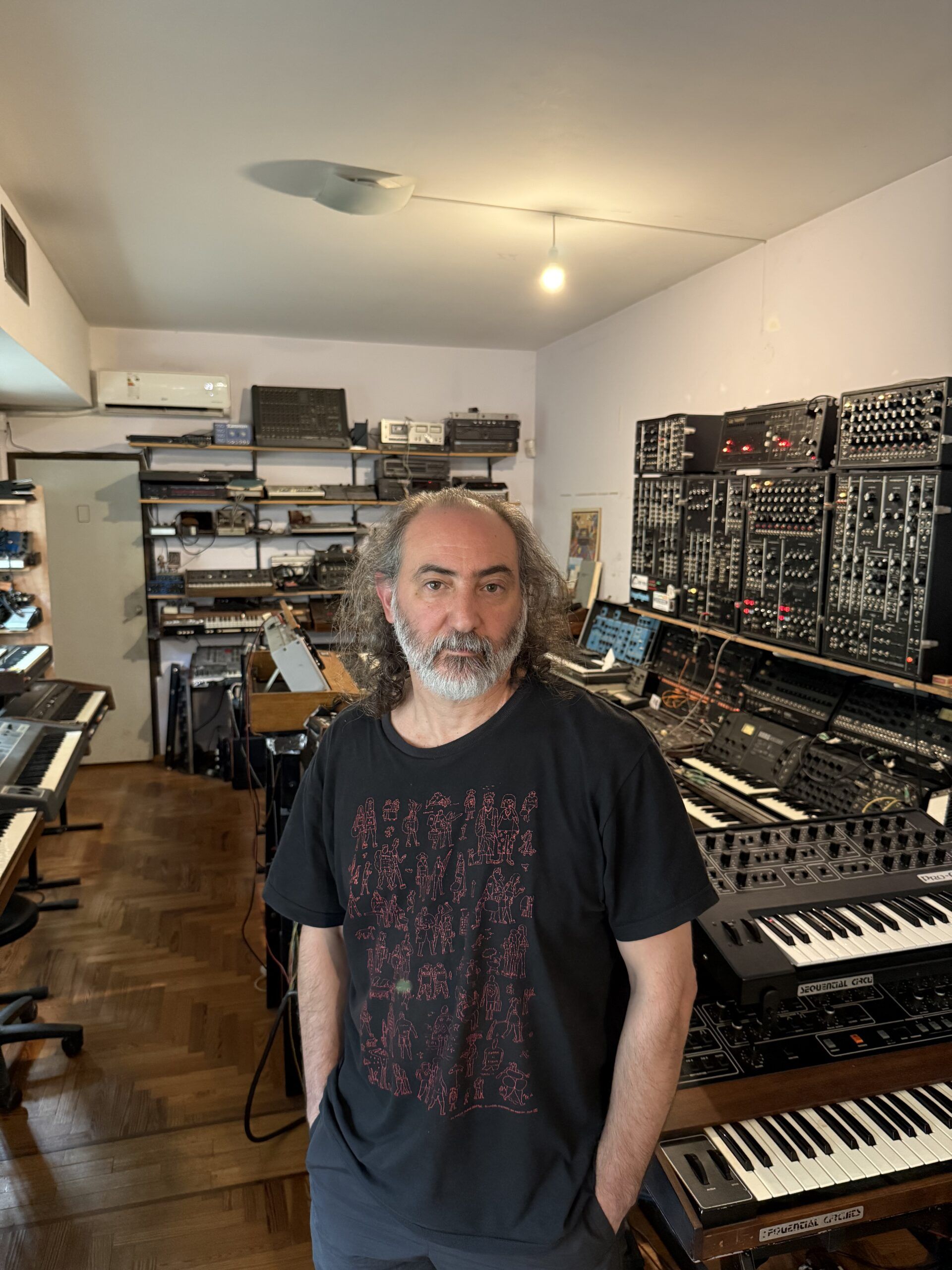
We visited La Siesta del Fauno, Ernesto Romeo’s studio, on a Buenos Aires afternoon. Outside, the city steamed and sweltered; inside, silence carried an entirely different weight. You step into La Siesta del Fauno and time folds. A vault wafting with the metallic scent of warm transistors, where a Mellotron from the ’70s coexists with Buchla and Moog modulars that, like living electroacoustic creatures, seem to watch you. It’s a resonance zone: among cables, oscillators, and memories.
That constant hum—that “almost alive” energy emanating from standby equipment—is part of Ernesto Romeo’s life. He greets us with a serene smile and the eyes of someone who has spent thousands of hours in front of electroacoustic creatures. A name that, in the electronic music scene of Argentina and Latin America, is not just synonymous with vintage keyboards and patch cables: he is a modern alchemist whose mission goes beyond sound. To preserve, to experiment, to teach. To make the analog and the digital sacred. To jam between the past and the future.
The Childhood of Voltage
Before the studio, before Klauss, even before the Prophet-5 he got in exchange for the wheels of a Fiat 600, he was a kid with Vangelis records in his head and the desire to tame unbridled energy.
“When I first wanted to be a musician, it was through listening to electronic music records,” Ernesto recalls. By age 20, in 1988, he’d finally acquired his first synthesizer. It was the beginning of a bond that would become not just musical, but almost philosophical.
That bond soon became a collection: Romeo began recovering, reviving, and caring for analog synthesizers as if they were relics of the future. His brother Lucas was an accomplice from the start. “My brother got this Pro One in a subway,” he says, like telling an archaeological discovery.
One of his most intimate treasures is an EMS Synthi AKS that belonged to Argentine composer Alicia Terzian. She had bought it in the ’70s and later stopped using it. Romeo acquired it in 1994. He keeps it, he loves it. Not just for its sound. For its history.
“It’s not about nostalgia,” he might say. “It’s about warmth. Voltage. Soul.”
Full video
Anatomy of a Sonic Alchemist
For Romeo, synthesis is not just technical. It’s sonic politics. It’s aesthetics. It’s language. “Over time I realized there is an aesthetic identity to the electronic, which has to do with the property of sharing control with electricity,” he says in a recent interview.
There’s something in that phrase that explains a lot. In his way of creating, machines don’t obey: they dialogue. Synthesizers are not tools; they are semi-autonomous companions.
“The fact of being able to let something play and for that to generate an evolving organism—that, beyond musical genre, speaks to a property of electronic music or electronic sound art,” he explains.
That intimate relationship with electricity even redefines what we consider music. Because if tradition demands constant human gesture, synthesis can open a plane where sound self-organizes, where energy is also expression.
That connection Romeo achieves between synthesis, intuition, and voltage is not technical: it’s visceral.
La Siesta del Fauno
The project was born in 2011, alongside Pablo Gil, a friend and technician he met in the ’90s while teaching at ORT. What began in the 1990s as a rehearsal room for Ernesto and Klauss transformed, over time and particularly with the founding of La Siesta Del Fauno, into one of the most important sound laboratories in the region.
Located in Buenos Aires, La Siesta del Fauno resembles a secular temple. Three rooms. Hundreds of instruments. Acoustic panels, keys that smell of old wood, low lights. Every corner seems designed to provoke an emotion, a discovery.
There, vintage synthesizers, Eurorack modular synthesizers, analog processors, digital equipment, electronic drums, grand pianos, and Hammond organs coexist. Some instruments were rescued from abandonment. Others were exchanged in adventures worthy of a novel. All of them have a history.
The studio’s name—taken from Debussy’s symphonic poem—is an aesthetic key. A siesta out of time, where the faun (half man, half beast) plays his flute and stops the world. That’s what they do there: stop time with sound.
It functions as a professional studio, as an open classroom, and as a sonic museum. Everything from pure experimentation sessions to albums like Bajofondo’s has been recorded there, capturing “the life” of analog synthesizers. “A CS80 line became the protagonist without trying,” they say. “That’s how these machines work, they suggest things.”

It’s not an exaggeration to say La Siesta del Fauno houses one of the largest active collections of analog synthesizers in the Southern Hemisphere. But Romeo doesn’t showcase them as trophies. They are living tools.
Among the favorites are classics like the MiniMoog, ARP2600, EMS Synthi AKS, Yamaha CS80 and DX1, Korg PS3300 y MS20, Buchla, Moog modular, Roland 100m, E‑Mu, Mellotron. There are also lesser-known gems: the Kawai 100F, with which Ernesto learned analog FM synthesis, or the Waldorf Wave.
“What’s most in demand today are hybrid sessions,” he explains. That is, combinations of vintage synthesizers with field recordings, improvisation, or acoustic instruments. There’s also demand for personalized classes: how to modulate, how to compose without a score, how to understand that a patch can be a form of thought.
The interesting thing is that many young musicians aren’t trying to emulate a “retro” sound. They’re seeking soul. That heat, that tension, that unpredictability that plugins, with all their versatility, don’t have.
In a corner of the studio, surrounded by cables and books, Romeo teaches. But not from the solemnity of a podium, but from the excitement of a child who just discovered a new kind of cross-modulation. His teaching work—in institutions like ORT, UNTREF or international universities—is also part of the project.
“I’m not interested in teaching closed formulas,” he says. “I prefer someone to understand what’s happening when modifying a parameter, to get lost and discover something.”
That idea runs through all his pedagogy: teaching, for him, is enabling detours. Making error function as a compass. Losing fear. Understanding that a wrongly turned knob can be the start of a new style.
La Siesta del Fauno also functions as a living classroom. Workshops, clinics, and meetings are offered for musicians, producers, and the curious. From introductory classes to advanced modular synthesis sessions. There have also been talks on the history of electronic music and sound design.
In a recent masterclass at 343 Labs (Nueva York), Romeo explained that many current synthesis concepts were already present in analog machines from the ’70s. What’s missing today, he suggests, is the physical bond, the error, the beautiful accident. “When everything is perfect, it becomes boring,” he says.
Although his role as a teacher and sonic curator is central, Romeo has never stopped creating. His is not a static museum. It’s a space in motion. The projects that have emerged or passed through La Siesta del Fauno in recent years prove it.
In 2024, alongside the Outro collective, he presented “Manto Bruma: Electroacoustic Symphony,” an immersive concert with Buchlas, altered pianos, and field recordings. A work halfway between installation, ritual, and improvisation.
He also collaborated with Bajofondo, the ensemble led by Gustavo Santaolalla, recording parts of their album Presente at La Siesta del Fauno to capture the raw analog vibration of synthesizers—alive, untamed, and minimally edited. “On that record, each take is almost a performance,” he explained.
He remains active with his project Klauss, a cult band in Argentina’s experimental electronic circuit since the late ’80s. Although they don’t release albums frequently, their performances are hypnotic journeys where time and groove bend. It’s not dance music. It’s electric trance.
Ernesto Romeo’s figure has grown as a reference not only in Argentina but also in Latin America and Europe. His name appears alongside artists like Suzanne Ciani, Morton Subotnick or Alessandro Cortini, with whom he shares a vision: the synthesizer as a poetic extension of body and mind.
He’s been invited to international festivals, sonic laboratories, and residencies. From Barcelona to Berlín. But his role as a mentor in the local scene is even more significant. Young musicians seek him not only for his technical knowledge but for his sensitivity.
There’s no vanity in the way he speaks. No branding. Just devotion. And that’s rare.
In a world where everything is measured by followers and algorithms, Romeo continues to believe in a different alchemy: the voltage that moves.
Some might see his crusade for analog gear as a form of technological fetishism. But that would be staying on the surface. In reality, Romeo fights something deeper: emotional obsolescence.
In an environment where sounds have become presets, where textures are copy-pasted, he insists on the uniqueness of the moment. Every recording at La Siesta del Fauno is unrepeatable. Every interaction with a synthesizer, unique.
“Most digital synthesizers from the ’80s and ’90s didn’t give you direct access to the parameters. Everything was cryptic. A tiny screen, a number, a value. That disconnected you,” he once said. That’s why he defends the physical interface. Because turning knobs is turning meaning.
That philosophy is not just sonic. It’s political. It’s affective. It’s, ultimately, a defense of human experience.
The Last Patch
A day at La Siesta del Fauno never has a clear ending. There are no rigid schedules. Sometimes, an idea born in an FM synthesis masterclass becomes, hours later, a texture in a play or the base for a collaboration with another artist. What happens there doesn’t follow industry logic. It follows the pulse of curiosity.
That approach defines why La Siesta del Fauno is different from any other recording space. Not just for how each corner of the studio sounds. It’s not the number of machines that impresses, but their layout, their history, their character. A CS80 can be the whisper of an atmosphere or the scream of a climax; a Buchla, a dialogue with chaos. They’re not there to be displayed: they’re there to be provoked.
“It’s not about what sounds more ‘analog’,” say those who’ve recorded there. “It’s about what sounds more alive.”
And from that crossing between the technical and the emotional, the ancestral and the futuristic, Ernesto Romeo becomes central to Argentine electronic music. Not just for his talent—which he has—nor for his knowledge—which is immense. But because he’s created a space where we listen differently. Where the past becomes electrified and the present slows down just enough for us to feel it.
A bridge between eras. A sensitive hacker. A pioneer who doesn’t look back—he breathes deeply, and switches the synthesizer back on.

